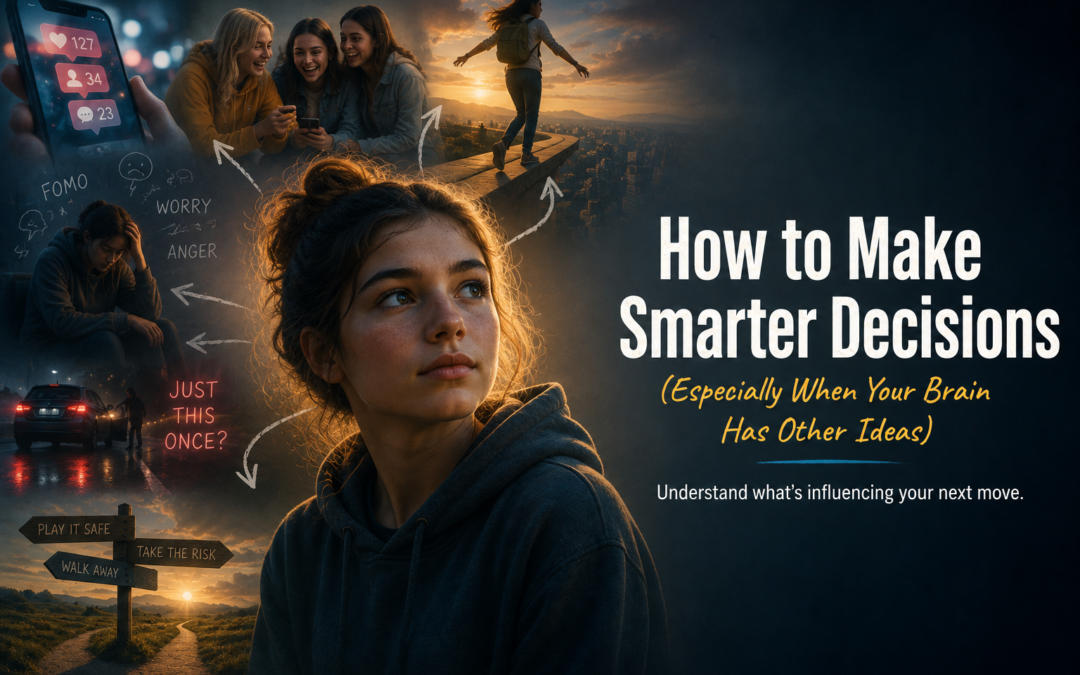
Five things every young person should understand about their brain, pressure, risk and the decisions they make.
Have you ever done something that seemed like a perfectly reasonable idea at the time — only to wonder afterwards: Why on earth did I do that?
Welcome to being human.
And during adolescence, there's another interesting factor at play: your brain is going through an extraordinary period of development. That doesn't mean you’re incapable of making good decisions. Far from it. Adolescence brings curiosity, creativity, openness to new experiences and an increasing drive for independence. But it can also mean that reward, emotion, excitement and what other people think can sometimes have a surprisingly powerful influence on what you do next.
Understanding that gives you an advantage. Because smarter decision-making isn't about always getting it right. It's about understanding what might be influencing your decision before you make it.
Five things that can help:
1. Understand your developing brain
Know why a decision can feel very different ‘in the moment’ than it does afterwards.
Example: Everyone’s laughing, you’re excited and posting the video seems hilarious. The next morning? Not quite so funny.
2. Think about risk AND reward
Risk isn't automatically bad. Learn to distinguish between a risk worth taking and one where the potential downside simply isn't worth it.
Example: Trying out for the team and risking rejection? Worth it. Getting in a car with someone who’s been drinking? The downside is far bigger than the reward.
3. Understand friends, belonging and influence
Other people affect our decisions — often without us noticing.
Example: You’d probably say no if you were alone. But when all your friends are doing it, suddenly saying yes feels much easier.
4. Recognise your pressure points
Excitement, embarrassment, attraction, anger, urgency and FOMO can all change the way we think.
Example: Someone sends a message that makes you furious. Firing back immediately feels great — until you’ve had ten minutes to think.
5. Create Personal Rules
Make some important decisions before you're under pressure to make them.
Example: “I don’t get in a car with someone who’s been drinking.” Decide it now, and there’s less to decide when everyone’s telling you to get in.
Let's look at each one.
1. Your Brain Is Still Building Its Braking System
Here's something worth knowing.
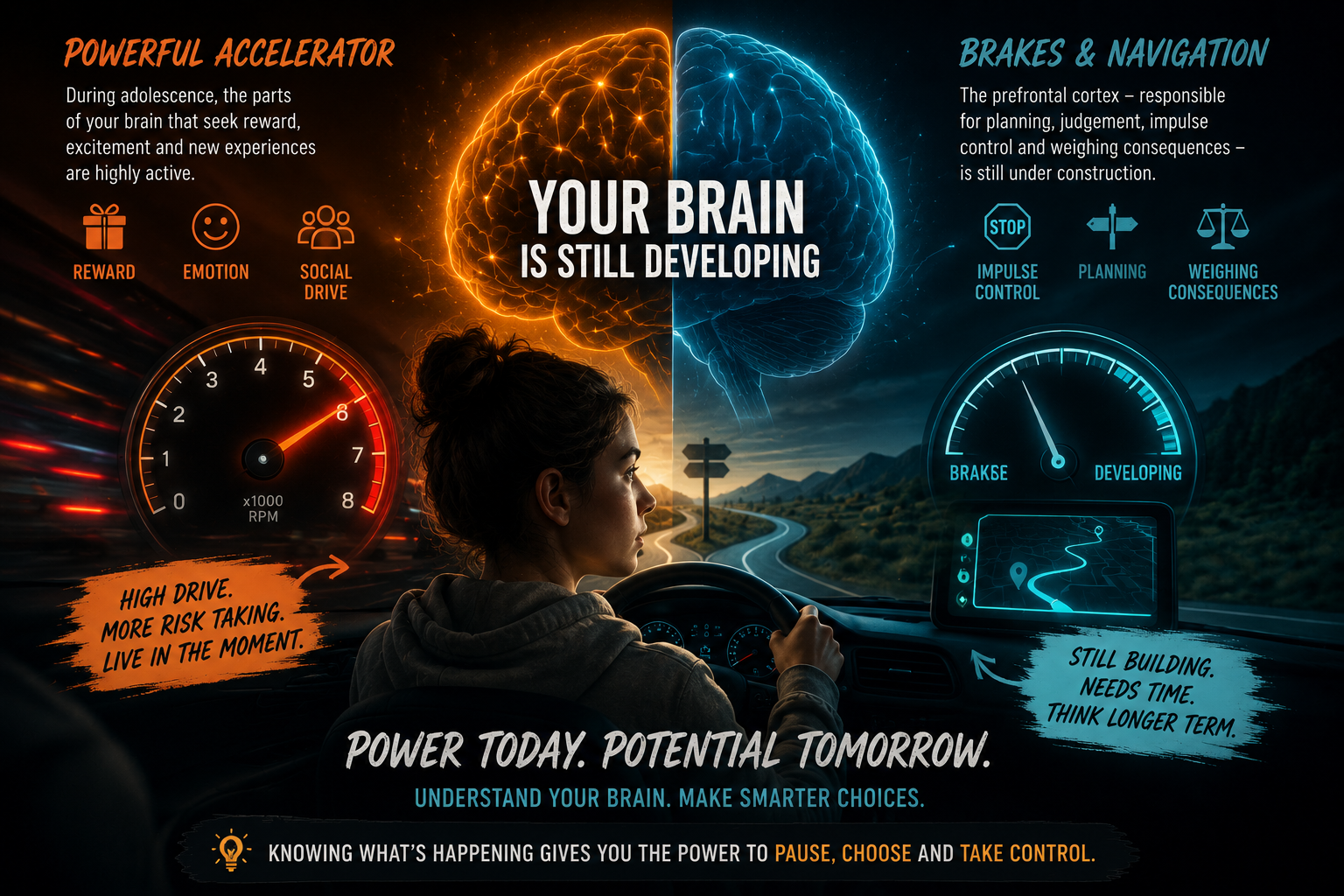
During adolescence, the brain doesn't simply get bigger. It undergoes significant reorganisation and refinement. There’s one area that’s still maturing. It’s the prefrontal cortex — involved in things such as planning, weighing consequences, impulse control and decision-making. Meanwhile, systems involved in reward, emotion and social information can be particularly influential during adolescence.
One way of thinking about it is this:
You've got a powerful accelerator, but the braking and navigation systems are still being refined.
That's not a design fault. The willingness to explore, take risks, meet new people, challenge ideas and become independent is part of how we grow. But it does help explain why:
"Everyone's doing it."
"It'll be funny."
"What's the worst that could happen?"
"I'll just do it this once."
…can occasionally win the argument.
And here's the useful bit: Knowing what's happening gives you a chance to interrupt it.
When something feels exciting, urgent or emotionally charged, that's often precisely when it's worth giving yourself a little more thinking time.
2. Risk Isn't the Enemy
We sometimes talk about risk as though good decision-makers avoid it. They don't.
Imagine never risking:
- asking someone out on a date,
- trying a new sport,
- speaking in front of people,
- travelling somewhere unfamiliar,
- applying for something you might not get,
- or admitting you want something different from your friends.
A life without risk would be pretty limiting. The smarter question isn't:
“Is this risky?”
It's:
“Is this risk worth the possible reward — and can I live with the downside?”
There's a huge difference between the risk of auditioning for a play and the risk of getting into a car with someone who's been drinking.
Both require a decision, but the potential consequences aren't remotely comparable.
A useful habit to get into is to mentally fast-forward:
If this goes brilliantly, what happens?
If this goes badly, what happens?
Which outcome has the bigger consequences?
Suddenly, “Should I?” becomes a much better question.

3. Your Friends Can Change Your Decisions Without Saying a Word
Peer pressure isn't always someone standing there saying:
"Go on. Do it."
Often, nobody needs to say anything. Human beings are wired to pay attention to other people. We notice what the group is doing, what's considered normal and whether we feel included. And during adolescence, social acceptance can carry particular weight. That's why you might make one decision sitting alone in your bedroom and a completely different one when five friends are standing beside you.
It doesn't mean you're weak. It means you're human. The trick is learning to notice when belonging is beginning to compete with your own judgement.
Ask yourself:
“Would I make the same decision if nobody else were here?”
That's a surprisingly powerful question.
If the answer is no, you've just discovered something important about what's influencing your next move.
4. Know Your Pressure Points
We all have them. For one person it might be embarrassment, another, anger, excitement, attraction, rejection, competition, fear, FOMO, or wanting to impress someone.
And then there's urgency.
"Quick!"
"Decide now."
"Don't tell anyone."
"You've got five minutes."
Pressure reduces the space we feel we have to think. So one of the smartest things you can learn is that feeling pressure doesn't mean you have to move faster.
Often it means the opposite. Discomfort is data.
If something suddenly feels wrong, confusing, rushed or uncomfortable, you don't necessarily need to know why before giving yourself permission to pause.
You can buy time. Ask another question. Check something. Call someone. Leave. Change your mind. A pause is still a decision.

5. Make Some Decisions Before You Need Them
This is where we introduce something we call Personal Rules.
Imagine this situation. You're at a friend's house, and somebody suggests getting into a car with an older friend who's been drinking.
That's not a particularly good moment to begin a philosophical debate with yourself about acceptable risk. You're surrounded by friends. Everyone wants to go. Nobody wants to be the awkward one. And suddenly the decision isn't simply about the car. It's about belonging.
What if you'd already decided:
I don't get in a car with someone who's been drinking. Now there's less to negotiate. The decision was made when your head was clear. The same principle can apply to all sorts of things:
- what you'll share online,
- how you'll allow someone to speak to you,
- what substances you will or won't try,
- what you'll do if a friend pressures you,
- when you'll leave a situation,
- or who you'll call if something feels wrong.
A Personal Rule isn't somebody else's rule imposed on you. It's a decision you've made for yourself. And that's what makes it powerful. You Won't Always Make the Perfect Decision. None of us do. That's important.
Being a smart decision-maker doesn't mean never getting carried away, trusting the wrong person, taking the wrong risk or wishing you'd done something differently. Sometimes you'll get it wrong.
What matters next is another skill: How do you respond when things don't go to plan?
That's where Emotional Resilience comes in — understanding your emotional responses, recovering from setbacks and preventing one difficult moment from becoming the whole story.
→ Discover your resilience style with our Character Test
But First: How Good Are You at Reading What's Really Going On?
Making a decision is difficult if you've misread the situation in the first place.
Can you spot when someone is influencing you? What about manipulation? Would you notice when something doesn't quite add up?
Can you distinguish between someone being persuasive and someone applying pressure or coercion?
That's Tactical Mindset — learning to pause, observe, question assumptions and look beyond what's immediately being presented to you.
Think you're pretty switched on?
→ Take the Tactical Mindset Quiz
What If Thinking Isn't Enough?
Most difficult situations are better avoided early. Good awareness, good decisions and strong verbal boundaries can prevent many situations from going further. Occasionally, a boundary is ignored. That's why Live Ready doesn't stop at mental agency.
You’ll also develop verbal and physical agency — practical ways to create distance, communicate clearly, move effectively and respond if avoidance is no longer enough.
The goal isn't to create fighters. It's to create capability before crisis.
Could you respond under pressure?
→ Try the Live Ready Drill
The Four Skills Behind Live Ready
There's a simple idea behind everything we teach:
CHOOSE. READ. MANAGE. RESPOND.
Smarter Decisions — I choose for myself.
Tactical Mindset — I read the situation.
Emotional Resilience — I manage myself.
Instinctive Self-Defence — I know how to respond.
We can't know exactly what life is going to put in front of us, but we can become better prepared for whatever life throws our way.
Live Ready
Skills for better decisions. Skills for real life.