
Live Ready - Duke of Edinburgh Skills Award - Bronze

- Description
- Curriculum
- FAQ
- Reviews
- Grade
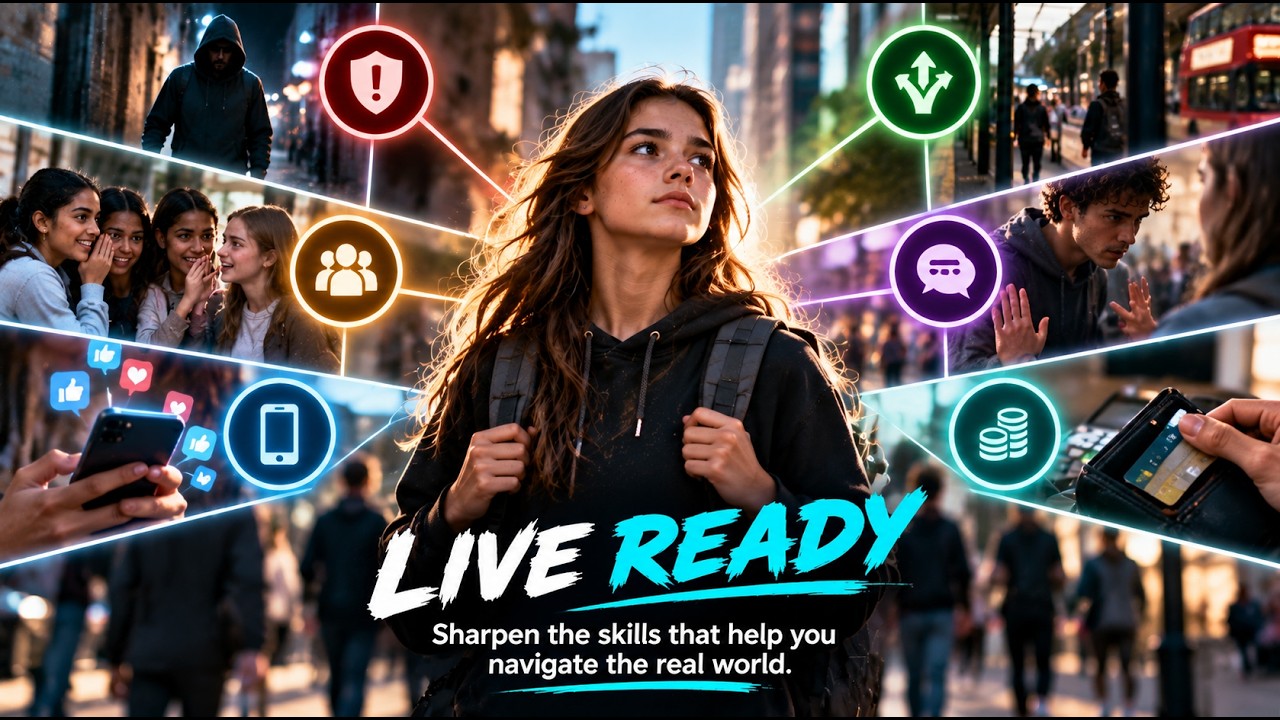
Live Ready: See What’s Really Going On
The world is full of influences, pressures and distractions competing for your attention. The better you understand what’s happening around you — and what’s happening inside you — the better your decisions can become.
Live Ready is where you start learning to see the world differently.
You’ll explore how perception shapes what you notice, why your brain sometimes switches to autopilot, and how emotions, ego, social pressure and influence can affect the choices you make.
You’ll discover how to:
- Recognise Influence — Understand how people, environments and digital platforms can alter your perception and behaviour.
- Take Control of Decisions — Learn how emotions, pressure and autopilot thinking can affect your choices — and how to create personal rules that keep you in control.
- Read People and Situations — Develop a sharper awareness of what is happening around you, including the subtle signs that something isn’t quite right.
- Handle Pressure — Explore how anger, rage, ego, social pressure and herd mentality can change behaviour — including your own.
- Communicate with Purpose — Begin developing the ability to use your words, presence and behaviour to influence situations rather than simply react to them.
- Build Physical Readiness — Start developing practical responses that help you act when a situation demands more than words.
But this isn’t simply about learning what to do.
You’ll be challenged to think.
Through interactive scenarios, quizzes, visualisation and practical drills, you’ll start connecting what you learn with how you actually behave.
By the end of Level 1, you’ll have started building something far more valuable than a collection of techniques:
The ability to see. Think. Decide. Act.
This is where you start becoming Live Ready.
-
1
 A Parent & Student Guide to Maximising the Live Ready Experience
The bronze level 1 is a high-impact, holistic operating system for life designed to fit seamlessly into busy modern schedules through 10-to-12-minute micro-lessons powered by Habit Stacking—the science of anchoring new growth to automatic, daily routines like commutes or morning habits.
Supported by an active accountability architecture of smart notifications, private peer forums, and competitive leader boards, this program eliminates friction to keep students consistently moving forward.
Far more than a traditional safety course, it serves as an incubator for the mind that yields a massive return on investment, instilling ancient and modern focus disciplines, elevating performance under pressure, and building unbreakable Identity Armour.
Ultimately, Live Ready refuses to cultivate a mindset of fear or blame; instead, it ensures that when young people finally "fly the nest," they do so as radically autonomous, highly savvy individuals who look out at the world and see an expansive landscape of opportunity ready to be seized.
-
2
Enter Community Chat
Have a question? Want to share an experience, or find out how other people are getting on, then click 'open course community' button and share the Live Ready experience.
-
3
 Lesson 1: Perception & Personal Rules (Introduction)
This introduction to Live Ready will show you why this is the best DofE course to build instinctive life skills that will help you spot more opportunities in life, and shut down threats.
Discover how your brain filters reality and how that perception controls your choices.
Learn how to build "Personal Rules" that act as automatic shields to keep you smart and safe under pressure.
-
4
Lesson 2: Split Second Decisions & Autopilot
Pressure-test your judgment: Use a common real-world scenario to see how your perceptions and personal rules hold up when things move fast.
Expose the mental gaps: Understand how your brain uses "autocomplete" to make split-second decisions and why filling in the gaps with assumptions can be dangerous.
-
5
Lesson 3: Reaction Speed & Distance Control
The Biological Gap: Compare human reaction speed to other mammals to see why you are naturally at a disadvantage—and why distance is your ultimate "weapon."
Physical Agency Skills: Learn "Fortress Ready" and "Calming Hands" to protect your space and instantly flip an aggressor’s perception of you from a "target" to a self-aware, controlled individual.
-
6
Lesson 4: Dominant Emotions and Decisions
Deconstruct the "Cognitive Hijack": Learn how your internal chemistry shifts under pressure and how biochemical triggers can take over your decision-making.
Master the Anger Scale: Understand the critical difference between feeling anger and tipping into rage, and how to process emotions before they override your control.
-
7
 Lesson 5: Interactive Quiz L1: 1-4
 -
8
Lesson 6: Defence Against the Rage
Face the Reality of Rage: Accept that while tactical and verbal agency are powerful, they aren't magic. Sometimes, a person's emotional "hijack" is too deep for words to reach, and you must shift instantly from talking to protecting.
The Shield & Move: Master the "Elbow Shield"—a natural, instinctive guard—and sync it with your footwork to create a moving fortress that keeps you safe under pressure.
-
9
Lesson 7: Ego, Identity & Strategic Surrender
-
10
Lesson 8: Social Pressure & Herd Influence
-
11
Lesson 9: Manipulation, Grooming & Psychological Influence
-
12
Lesson 10:Interactive Quiz L1: 6-9
-
13
Lesson 1: Algorithms, Dopamine & Digital Control
Algorithms aren't necessarily "bad"; they are systems designed to predict and influence behaviour.
In this lesson we explore recommendation algorithms, personalisation, engagement, data, why your feed isn't the same as somebody else's, how algorithms learn from your behaviourm and the difference between choosing something and being repeatedly presented with it
-
14
Lesson 2: The Business of Attention and Outrage
Attention has economic value. Learn about how things work to capture your engagement and the business of the attention economics.
-
15
Lesson 3: Opinion, Beliefs & Shaping our Identity
We've already explored influence and manipulation and here we go a step further and see how it impacts our long term belief system.
-
16
Lesson 4: The Victim in All of Us
There is nothing wrong with feeling sorry for yourself from time to time. Sometimes there is a very real reason to feel sad and fed up with something, but making this a habit with everything that doesn't go your way can really hold you back in life. This lesson explores how we can turn disappointment into fuel for personal growth.
-
17
Lesson 5: Interactive Quiz L2: 1-4
-
18
Lesson 6: The Comparison Trap
Having hero's to look up to and admire is natural. Comparing ourselves to others can cause stress and doesn't aid personal growth.
-
19
Lesson 7: Validation is Out of Control
It's natural to want recognition for what you do and who you are, but when it becomes a 'need' it can end up becoming addictive and leading your down a very unhappy path.
-
20
Lesson 8: The Patience of Delayed Gratification
Next day delivery is now the norm when we order something, but those that build things patiently over time have the best things delivered in the end.
In this lesson you'll see how micro learning leads to growth and the things you most desire.
-
21
Lesson 9: Your Reputation Arrives Before You Do
Building that reputation that creates opportunities without even trying is the ultimate position to aspire to. In this lesson we show you how to start that journey.
-
22
Lesson 10: Interactive Quiz L2: 6-9
-
23
Lesson 1: The Power of Presence
Before you say a word, you're already communicating. Explore how posture, expression, eye contact, movement and energy influence how others perceive you — and how you perceive yourself.
-
24
Lesson 2: Stop Talking, Start Asking
Great conversations aren't won by saying the most. Learn why asking good questions, showing curiosity and getting people talking can transform the way people respond to you.
-
25
Lesson 3: Listen Like It Matters
Listening is more than waiting for your turn to speak. Discover how paying genuine attention helps you understand people, build trust and notice things others miss.
-
26
Lesson 4: Confidence Without the Ego
What's the difference between confidence, arrogance and insecurity? Explore how genuine confidence comes from being comfortable with yourself rather than constantly needing approval or validation.
-
27
Lesson 5: Interactive Quiz L3: 1-4
-
28
Lesson 6: Your Words Have Power
Communication isn't simply about what you say. Explore tone, timing, body language and choice of words — and how small changes can completely alter the way your message is received.
-
29
Lesson 7: The Power of No
You don't need to be aggressive to have boundaries. Learn how to say no, disagree, challenge something and stand your ground without unnecessarily creating conflict.
-
30
Lesson 8: Read the Room
Every situation has signals that aren't spoken aloud. Learn to notice people's behaviour, group dynamics, mood and context so you can adapt rather than blindly follow the same approach everywhere.
-
31
Lesson 9: Conversations Create Opportunities
-
32
Lesson 10: Interactive Quiz L2: 6-9
-
33
Lesson 1: Where Do You Draw the Line?
Boundaries aren't just rules for other people — they're decisions about what you're comfortable with and what you're not. Explore personal boundaries and why knowing your own limits makes it easier to recognise when they're being crossed.
-
34
Lesson 2: Pressure Changes People
Why do we sometimes do things we wouldn't normally choose to do? Explore peer pressure, emotional pressure, authority and the fear of disappointing others — and learn to recognise when pressure is influencing your decisions.
-
35
Lesson 3: When "No" Isn't Accepted
Saying no is only the beginning. Learn how to recognise when someone is ignoring, challenging or repeatedly pushing against a boundary, and how to respond without being drawn into an unnecessary confrontation.
-
36
Lesson 4: Conflict: Fuel or Fire?
Conflict doesn't always need to become a fight. Discover how your words, body language, emotions and timing can either escalate a situation or help bring the temperature down.
-
37
Lesson 5: Interactive Quiz L4: 1-4
-
38
Lesson 6: The Manipulation Playbook
Manipulation can be subtle. Revisit the influence skills from earlier levels and explore tactics such as guilt, pressure, flattery, threats, emotional blackmail and turning the blame back onto you.
-
39
Lesson 7: When Relationships Change
People don't always treat us the same way over time. Explore healthy and unhealthy relationship patterns, changing boundaries, control, respect and the warning signs that a relationship may be becoming unhealthy.
-
40
Lesson 8: Know When to Walk Away
Sometimes the strongest response isn't winning the argument — it's leaving it. Learn when continuing a conversation is pointless or unsafe, how to disengage without escalating the situation, and when to involve someone else.
-
41
Lesson 9: Your Boundary, Your Responsibility
Bring everything together. Learn to take responsibility for communicating your boundaries, recognising when they're being tested and choosing the response that best protects your wellbeing, relationships and future.
-
42
Lesson 10: Interactive Quiz L4: 6-9
-
43
Lesson 1: When Plan A Fails
Things rarely go exactly as expected. Learn why getting stuck on the original plan can make a situation worse, and how to quickly move from "This isn't working" to "What can I do now?"
-
44
Lesson 2: The Problem-Solving Mindset
Problems become easier when you stop reacting to them emotionally and start breaking them down. Learn how to identify the real problem, separate facts from assumptions and generate possible solutions.
-
45
Lesson 3: Adapt or Get Stuck
Adaptability isn't giving up — it's changing your approach when the circumstances change. Explore how flexible thinking can help you respond to setbacks, uncertainty and unexpected challenges.
-
46
Lesson 4: Initiative: Don't Wait to Be Told
Opportunities and problems don't always come with instructions. Learn when to take responsibility, act without waiting for permission and become someone who looks for solutions rather than waiting for someone else to provide them.
-
47
Lesson 5: Interactive Quiz L5: 1-4
-
48
Lesson 6: Risk Without the Fear
Taking risks is part of life. Learn to distinguish between reckless risk, calculated risk and unnecessary risk, and develop a simple way to think about potential consequences before acting.
-
49
Lesson 7: Find the Opportunity
A setback isn't always just a setback. Sometimes a change of plan reveals an opportunity that wasn't visible before. Learn to look beyond the immediate problem and ask:
"What could this make possible?" -
50
Lesson 8: Pressure Test Your Thinking
When the pressure rises, our thinking can become narrower. Bring together everything you've learned about perception, emotion, ego, influence and decision-making to practise staying calm enough to think strategically.
-
51
Lesson 9: Become the Person Who Can Adapt
The final lesson brings the entire Live Ready journey together.
You can't control everything that happens to you.
You can develop the ability to understand what's happening, manage yourself, assess your options, communicate, set boundaries, take initiative and adapt when circumstances change.
The goal isn't to predict the future.
It's to become capable of meeting it. -
52
Lesson 10: Interactive Quiz L5: 6-9
It explores things that matter enormously in real life but aren't always taught in school — perception, influence, emotions, decision-making, communication, social pressure, digital behaviour, opportunities and personal safety.
It isn't about teaching young people to be afraid of the world. It's about helping them become more capable of navigating it.
Through interactive scenarios, quizzes and practical challenges, you'll discover how the world can influence you — and how you can respond with greater awareness and control.
Who is this for?
-
Students (Ages 12-18): Designed specifically for young people heading toward work, university, or travel.
-
Parents: You are welcome to follow along, join the discussions, and learn the framework alongside your teenager.
Train as a Team
You don’t have to do this alone. Team up with friends to create a training group and compete on our leader board. To get started, email info@pastraining.co.uk with your group name and the names of your members. We’ll get you set up with our points system and leader board access.
DofE Accreditation
Completing Live Ready fulfils the requirements for the Duke of Edinburgh’s Skills Award (Bronze).
- No equipment needed.
- Just 10–12 minutes a day — discover the power of microlearning and build practical skills through short, focused lessons.
- A willingness to learn and participate — you’ll get the most from Live Ready by engaging with the scenarios, questions and activities.
- Consistency beats intensity — a few focused minutes each day can build knowledge, confidence and habits that stick.
12-18 year olds.
Individual or groups.